


Almost 14 million face years-long recovery from the cost of living crisis
- Royal London's Financial Resilience Report 2026 shows one in four (25%) UK adults think they need three years or more to recover from high living costs
- The report introduces a new Financial Resilience Barometer, which places the average UK adult in the 'Economically Exposed' category
- Only 13% of men and 9% of women make it into the most resilient category; Robust and Resilient*
Millions of people across the UK** are still years away from recovering financially from the cost-of-living crisis, and the nation's overall financial resilience level shows many households are still very exposed if prices rise for basics such as food, fuel and energy, according to new research from Royal London.
Royal London, the UK's largest customer-owned life, pensions, and investment company has released its 'Financial Resilience Report 2026' which highlights that one in four UK adults, equivalent to 13,750,000, say it will take them three years or more to recover financially from the cost-of-living crisis.
Our research shows higher living costs continue to affect millions of people's finances and any recovery is uneven. Understandably, the more financially resilient groups have been less impacted, but almost half of UK adults (45%) say ongoing higher costs have affected their financial resilience in the last 12 months.
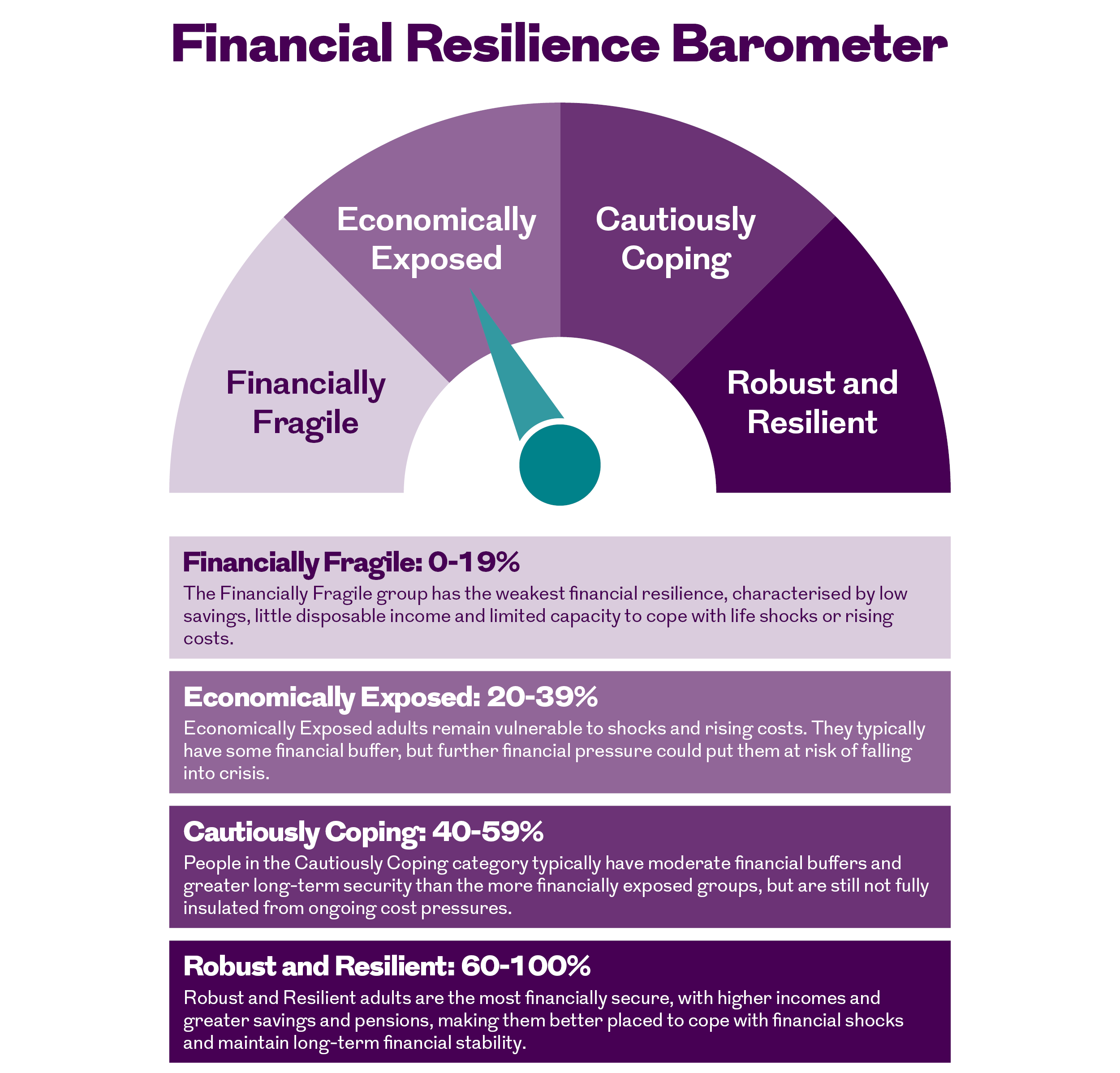
The report, in its third year, introduces a new Financial Resilience Barometer, which gives the overall rating for the UK as 'Economically Exposed', with an average score of 33%.*
The report findings highlight the scale and persistence of financial vulnerability across the UK:
- 30% of UK adults are classified as Financially Fragile, with low savings and limited capacity to cope with financial shocks.*
- Almost one in five (19%) adults have less than £100 in cash savings.
- Financially Fragile adults have just £77 of discretionary income each month on average.*
- More than a third (35%) of employees are Financially Fragile, showing that being in a job does not guarantee financial security.*
Financial vulnerability cuts across income, housing and age groups
Homeownership plays a major role in financial resilience. Those who own their homes outright are far more likely to fall into more resilient categories, while renters are significantly more likely to be financially vulnerable.
Income is an important factor, but the research shows that financial vulnerability is not limited to the lowest earners. While lower-income households are more likely to be Financially Fragile, a significant proportion of middle-income households are classified as Economically Exposed, with some higher earners also at risk.
Age also shapes financial resilience. Younger adults and working-age households are more likely to fall into the Financially Fragile and Economically Exposed categories, while those aged 60 and over are more likely to be Robust and Resilient, often reflecting stronger savings and housing positions.
Life events also play a critical role. Four in ten people who have experienced a major life event such as bereavement, illness or job loss in the past two years are financially fragile, compared with around a quarter (24%) who have not experienced a life shock.*
Sarah Pennells, Consumer Finance Specialist at Royal London, said:
"Our research shows that for millions of people, the financial recovery from the cost-of-living crisis will take years rather than months. It’s been over four years since the cost-of-living crisis started, but only three in ten adults, (29%) say they weren’t affected or have already recovered.
"While we’re starting to see some signs of improvement in people’s finances, almost one in five adults (19%) have less than £100 in savings, meaning they have very little by way of a financial cushion. Worryingly, this figure has barely shifted since 2023. A minority of people – one in ten – have less than £50 a month left over once they’ve paid for housing, bills and food. The reality is that millions of people are still living very close to the edge and may be only one bill shock away from financial crisis.
"Even more concerning is that having a job is no longer a guarantee of financial security, with many working households lacking the savings or financial buffer they need to cope with unexpected spending on repairs or rising prices for goods and services.
"This underlines the importance of building both short-term resilience, through cash savings you can easily access, and long-term security through pensions and financial planning."
Sarah’s key actions people can take to build financial resilience:
- Go through your bank and credit card statements to see where your money goes and if you can make any cutbacks.
- Build an emergency savings buffer, even if you can only afford a small amount each month, it’s better to have some emergency savings than none at all.
- Think - and talk about - the unthinkable. Could you pay your bills if you lost your job or couldn’t work due to illness? How would you cope if your rent or mortgage increased?
- Don’t put off pension saving. If you’re young, retirement may seem like a lifetime away, but it’s the money you invest early that has the longest time to grow and work the hardest. If you’re employed or on a contract, staying in your workplace pension means you’ll benefit from contributions from your employer.
- If you don’t know where to start, there’s lots of help available. Financial providers often have helpful tools, guides and calculators. The MoneyHelper website is a good source of impartial information and PensionWise offers a free guidance call to anyone over 50 with a defined contribution pension. One-on-one advice from a professional can help with planning for both the short and longer term, taking into account your personal priorities.
Sarah Pennells added: "However, for many households, the issue is not a lack of understanding, but a lack of money to improve their day-to-day finances, and ultimately their resilience. Taking small steps to build up savings and engage with longer-term planning can make a meaningful difference over time, so it’s really worth starting to make those changes sooner rather than later."
Notes to editors
All figures, unless otherwise stated, are from YouGov Plc. Total sample size was 4045 adults. Fieldwork was undertaken between 4th - 19th March 2026. The survey was carried out online. The figures have been weighted and are representative of UK adults (aged 18+).
Estimates of the number of UK adults who expect to pay housing costs were based on ONS estimates for population data, with a base number of 55 million UK adults.
*Data taken from Royal London’s Financial Resilience Report and calculated by Royal London’s Insight team.
**Based on 55 million UK adults as a base figure (ONS verified) 25% = 13,750,000.
Overview of Financial Resilience Barometer categories:
- Financially Fragile (0-19%): The Financially Fragile group has the weakest financial resilience, characterised by low savings, little disposable income and limited capacity to cope with life shocks or rising costs.
- Economically Exposed (20-39%): Economically Exposed adults have some financial buffer but remain vulnerable to shocks and rising costs.
- Cautiously Coping (40-59%): Those in the Cautiously Coping category typically have moderate financial buffers and greater long-term security than the more financially exposed groups but are still not fully insulated from ongoing cost pressures.
- Robust and Resilient (60-100%): Robust and Resilient adults are the most financially secure, with higher incomes and greater savings and pensions, making them better placed to cope with financial shocks and maintain long-term financial stability.
For further information please contact:
Nicki Parry, PR Manager
- Email: nicki.parry@royallondon.com
- Mob: 07919 170 043
About Royal London
Royal London is the UK's largest customer-owned life, pensions, and investment company, and one of the top 30 mutuals globally*. With over 160 years of heritage and no external shareholders, we're able to take a long-term view, focusing on supporting better outcomes for our customers.
Today, Royal London looks after 8.4 million life and pension policies, with £212 billion of assets under management and over 5,000 colleagues**. In 2026, we shared £199 million of our profits with approximately 2.4 million eligible customers.
We invest in partnerships that reflect our values, including being the only Founding Partner of the first British & Irish Lions Women's Team, supporting women's and girls' rugby across grassroots and elite levels to help develop the next generation of players and coaches. All driven by our commitment to doing what's right for our customers.
Royal London works for you.
Discover more at royallondon.com.
*Based on total 2024 premium income. International Cooperative and Mutual Insurance Federation Global data, 2026.
**Figures quoted are as at 30 June 2026.